Hormones & TRT
Clinical articles on hormones & trt, reviewed by NMC-registered specialists.
See how Kyros treats hormones & trt →
How to Tell a Legitimate Online TRT Clinic From a Risky One
Not every online hormone clinic is equally careful. Here are the concrete signs of a legitimate provider, and the red flags worth walking away from.
Reviewed by Dr. Alla Renuka · 5 min read

How Online Hormone Consultations Work: Your First Visit, Step by Step
New to online hormone or TRT consultations? Here's exactly what to expect: what to bring, what happens on the call, and what comes after.
Reviewed by Dr. Alla Renuka · 5 min read

Online Testosterone Therapy Cost in India: What You Actually Pay For
The headline consultation fee is only part of what TRT costs. Here's what an honest total looks like — consultation, labs, and ongoing monitoring.
Reviewed by Dr. Alla Renuka · 5 min read

Online vs In-Person TRT Consultation: Which Do You Actually Need?
Most testosterone care fits an online consultation well. Here's exactly what video can and can't do, so you can decide with your eyes open.
Reviewed by Dr. Alla Renuka · 5 min read

Is Online Testosterone Consultation Private and Confidential in India?
Hormonal health is personal, and discretion is a fair concern. Here's what real privacy protection looks like for online testosterone consultations.
Reviewed by Dr. Alla Renuka · 5 min read

Switching TRT Providers or Getting a Second Opinion: Your Options
Not happy with your current TRT care, or want another doctor's view? Here's how switching providers or getting a second opinion actually works.
Reviewed by Dr. Alla Renuka · 5 min read

Is Testosterone Legal to Prescribe Online in India? The Rules Explained
Testosterone is a prescription medicine in India, prescribable via telemedicine under specific rules. Here's exactly what those rules mean for you.
Reviewed by Dr. Alla Renuka · 5 min read

TRT, Fertility, and Reversibility: What Every Man Should Know First
Testosterone therapy affects natural sperm production. Here's what that means for fertility, what's reversible, and what to discuss before starting.
Reviewed by Dr. Alla Renuka · 5 min read

Testosterone Therapy Delivery Methods: How TRT Is Actually Given
Gel, injection, or another form — there's no single 'best' testosterone delivery method. Here's the plain-language landscape and how your doctor decides.
Reviewed by Dr. Alla Renuka · 5 min read

TRT Monitoring and Follow-Up: What Ongoing Care Actually Looks Like
TRT doesn't end at the prescription. Here's what ongoing monitoring actually involves — how often, what's checked, and what changes the plan.
Reviewed by Dr. Alla Renuka · 5 min read

TRT, Mood, Energy, and Sexual Health: What's Realistic to Expect
Can TRT help mood, fatigue, or sex drive? The honest answer: for a confirmed deficiency, often yes to some degree — but it's not guaranteed, and timing varies.
Reviewed by Dr. Alla Renuka · 5 min read

TRT Side Effects: What to Actually Watch For
Testosterone therapy has real, monitorable effects — not the vague fears the internet spreads. Here's what a doctor actually watches for, and why.
Reviewed by Dr. Alla Renuka · 5 min read

TRT vs Anabolic Steroids: Why They Are Not the Same Thing
TRT and anabolic steroid misuse get confused constantly. Here's the real medical distinction — and who TRT is, and isn't, appropriate for.
Reviewed by Dr. Alla Renuka · 5 min read

Women's Hormone Therapy Online in India: Menopause, HRT, and Testosterone
Menopausal HRT and, in specific cases, testosterone therapy for women are both legitimate medical treatments. Here's how online assessment works for each.
Reviewed by Dr. Alla Renuka · 5 min read

Lifestyle and Testosterone: What Actually Helps (and the Limits)
Can lifestyle support healthy testosterone? Sleep, weight, exercise and stress genuinely matter — here's what helps, and the honest limits of lifestyle alone.
Reviewed by Dr. Alla Renuka · 2 min read

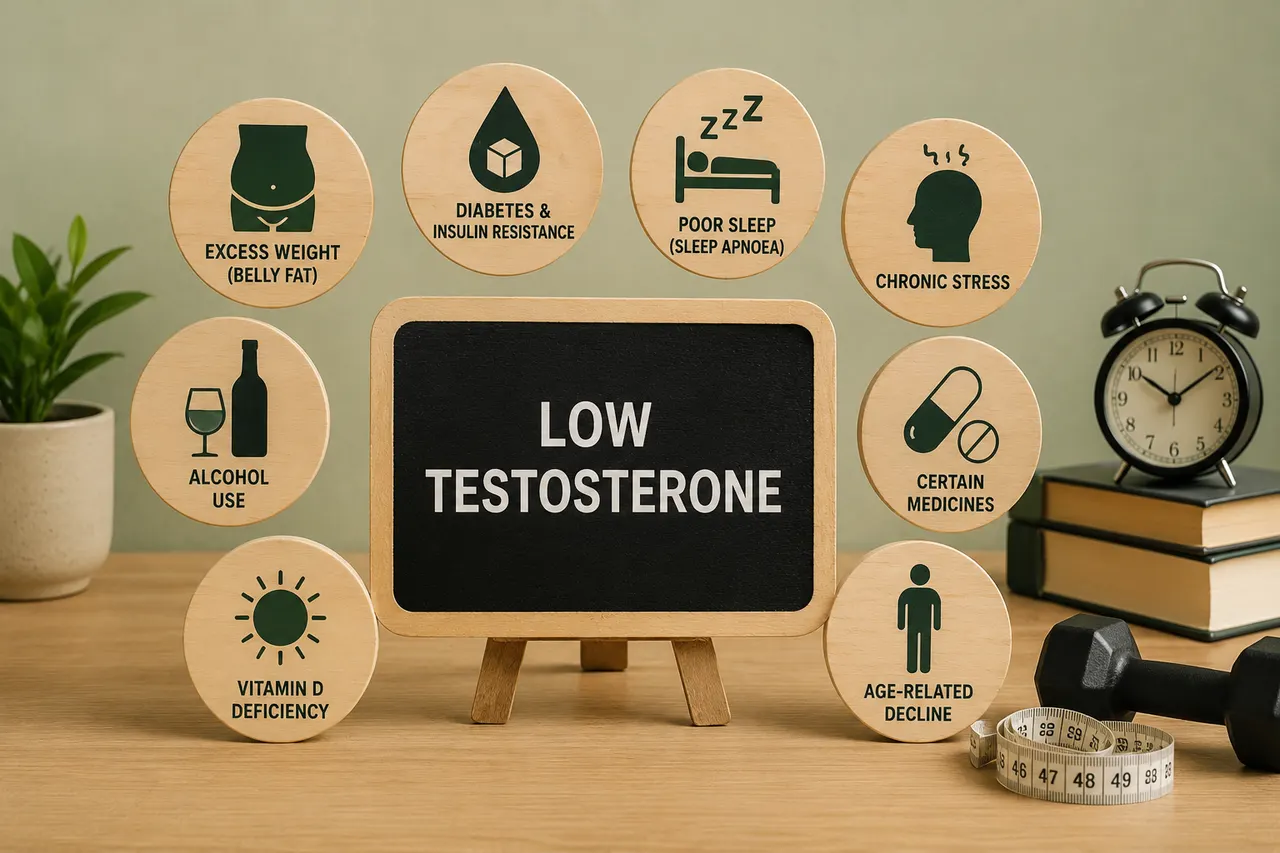
What Causes Low Testosterone? Common Reasons in Indian Men
Low testosterone often has a treatable cause — diabetes, obesity, stress, sleep. Here are the common reasons in Indian men, and why finding them matters.
Reviewed by Dr. Alla Renuka · 2 min read
Low Testosterone in Indian Men: Signs & What Your Doctor Checks
Tired, low drive, low mood? Low testosterone is more common in Indian men than thought. The signs, and the blood tests your doctor checks.
Reviewed by Dr. Alla Renuka · 2 min read
Testosterone Replacement Therapy in India: When It's Considered & How It Works
What is TRT, and when do doctors consider it? A clear, honest guide to testosterone replacement therapy in India — who it's for and how supervision works.
Reviewed by Dr. Alla Renuka · 2 min read
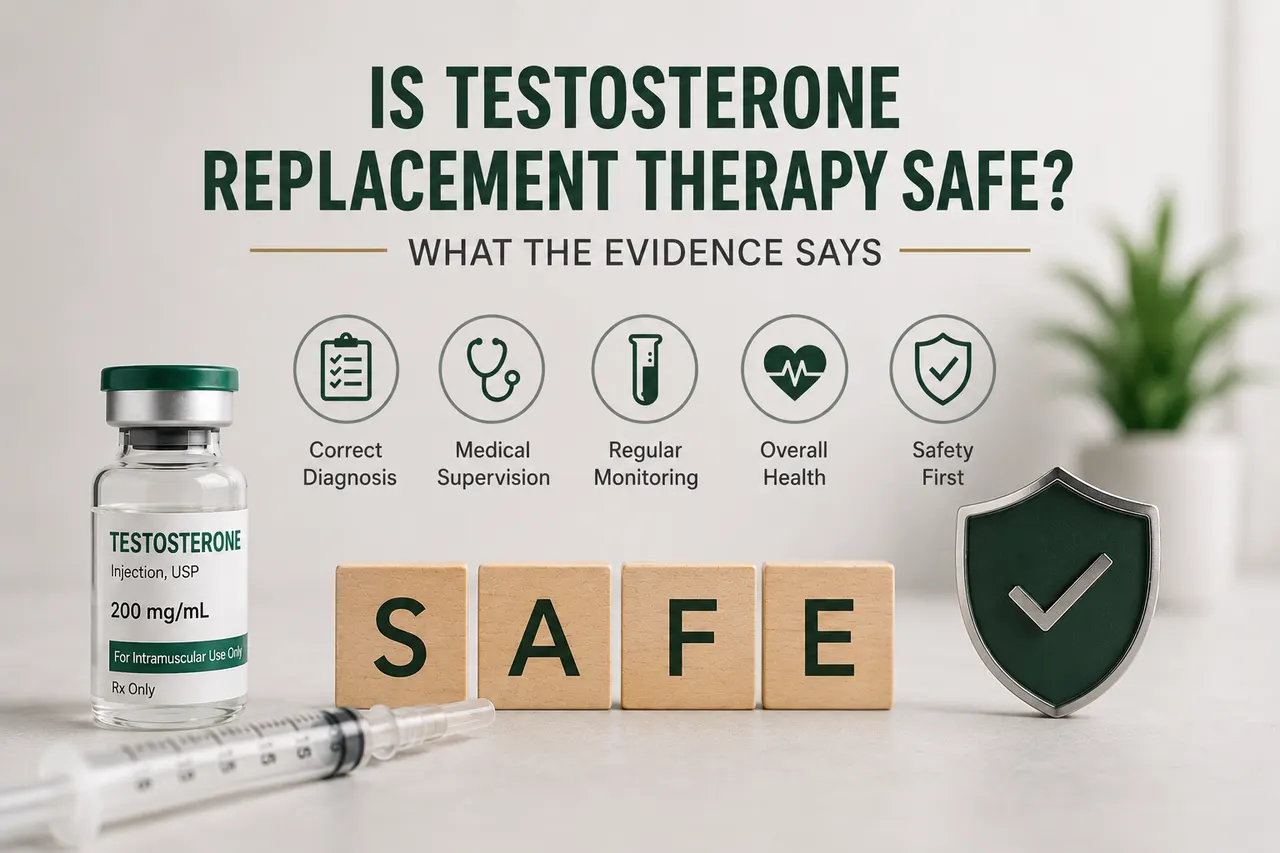
Is Testosterone Replacement Therapy Safe? What the Evidence Says
Is testosterone replacement therapy safe? The honest, evidence-based answer: it depends on correct diagnosis and monitoring. Here's what the evidence shows.
Reviewed by Dr. Alla Renuka · 3 min read
Testosterone Testing: Which Levels Matter and When to Test
Total vs free testosterone, SHBG, and morning timing — why your testosterone test can mislead. A plain guide to testing it the right way.
Reviewed by Dr. Alla Renuka · 3 min read
Questions people ask before an online hormones & trt consultation
Real questions from patients, answered directly.
- How much does online testosterone therapy (TRT) cost in India, including the cheapest realistic option?
- Cost depends on three parts: the consultation itself, baseline lab work, and ongoing follow-up visits. There's no responsible way to shop purely on price, since an unusually low headline cost usually means one of those three parts has been skipped. For more details, visit this blog post.
- What's the real total cost of TRT including consultations and lab tests?
- The all-in cost includes the initial video consultation, a proper baseline blood panel, and recurring follow-up consultations and repeat labs for as long as you're on treatment. A platform that only quotes the first number isn't showing you the real total. For more details, visit this blog post.
- Does health insurance cover TRT, and can I get treated without it?
- Coverage varies widely by insurer and policy, with diagnostic tests more commonly reimbursable than ongoing hormone therapy itself. For most people in India today, TRT is largely a self-pay treatment regardless of insurance status, so ask for itemised receipts either way. For more details, visit this blog post.
- Is online TRT more cost-effective than traveling for in-person treatment?
- The underlying medical costs — consultation, labs, monitoring — are the same either way, but online consultation removes the added cost of repeated travel and time off work for follow-ups. For most routine TRT care, that logistics saving is real, especially outside major cities. For more details, visit this blog post.
- How do online hormone consultations work, and what's included?
- You fill in a short intake form with your symptoms, history, and any existing lab reports, then have a video consultation where your doctor reviews everything and sets a plan — further tests, a treatment discussion, or a referral. For a first testosterone prescription, Indian telemedicine rules require this to happen over real-time video. For more details, visit this blog post.
- What questions should I ask during an online hormone consultation?
- Ask what tests are being ordered and why, how the plan will be monitored going forward, what would signal the plan needs to change, and how to reach your doctor between visits. A doctor who answers these plainly is a good sign about the quality of your care. For more details, visit this blog post.
- How quickly can I get my first consultation appointment, without waiting months for a doctor?
- Online platforms are generally not limited by a single specialist's local clinic hours, so first-appointment availability tends to be faster than booking an in-person endocrinologist visit in most Indian cities, where waits can run to weeks. For more details, visit this blog post.
- What medical records do I need, and how should I prepare for my first online consultation?
- Bring any recent testosterone, thyroid, or metabolic panels, a list of current medicines and supplements, and a brief note of when your symptoms started. If you don't have recent tests, your doctor can order the right ones during the visit. For more details, visit this blog post.
- Can I get multiple hormones managed through one online clinic?
- Often yes, if the concerns fall within one doctor's scope — testosterone and thyroid symptoms, for example, genuinely overlap and can reasonably be assessed together. If your case needs a specific specialist referral beyond that, a good doctor will say so directly. For more details, visit this blog post.
- What payment methods do Indian online hormone clinics accept?
- Most legitimate platforms accept standard Indian payment methods — cards, UPI, and net banking — through the same secure gateways used across other healthcare bookings. A platform asking for unconventional payment outside its own booking system is worth questioning. For more details, visit this blog post.
- Do I need a doctor's prescription for testosterone or HRT in India, or can I buy it online without one?
- Yes, a prescription is required. Testosterone is a Schedule H prescription medicine in India, and it cannot legally be sold over the counter by any legitimate source, online or offline. For more details, visit this blog post.
- Can I get testosterone prescribed online without ever visiting a doctor in person?
- Yes, but not without a real medical assessment. A first-time testosterone prescription legally requires a real-time video consultation under India's telemedicine rules, not just a text-based chat or form. For more details, visit this blog post.
- What hormones are available over the counter in India?
- Testosterone and other core hormone medicines are not available over the counter in India — they are Schedule H prescription drugs. Some supplements marketed as supporting hormone levels are sold freely, but they are not regulated as medicines and are not equivalent to prescribed hormone therapy. For more details, visit this blog post.
- Can hormone medications be shipped internationally from India, and are online Indian prescriptions valid in my country?
- Even where a treatment is legitimately prescribed within India, shipping a prescription medicine across borders and having a prescription honoured abroad depends entirely on the destination country's own customs, import, and pharmacy rules — something an Indian-licensed doctor cannot resolve on your behalf. For more details, visit this blog post.
- Do online hormone clinics in India accept international customers?
- Some accept international patients for consultation and assessment, but actually dispensing a controlled prescription medicine across a border depends on the destination country's own laws, separate from anything the Indian platform can guarantee. For more details, visit this blog post.
- Why are some doctors saying testosterone is unavailable or slow to prescribe it?
- It's usually not that the medicine is unavailable — it's that a careful doctor won't prescribe it without proper diagnosis and a video consultation first, and some general physicians, especially outside major cities, reasonably prefer to refer onward rather than prescribe outside their day-to-day experience. For more details, visit this blog post.
- Is it safe to buy hormones online from Indian pharmacies, and what are the risks?
- It's safe only when the pharmacy requires a valid prescription and is itself properly licensed. Buying from a source that skips the prescription requirement removes the medical safeguards — diagnosis, appropriate dosing, monitoring — that make hormone therapy safe in the first place. For more details, visit this blog post.
- How do I know if an online hormone or TRT clinic is legitimate, and how do I compare different ones?
- Check for named doctors with verifiable NMC registration, a required baseline blood test before any prescription, a real video consultation for new prescriptions, and clear identity verification — then ask every clinic you're comparing the same questions and see which answers plainly. For more details, visit this blog post.
- What should I look for on an online pharmacy's trust seal?
- A trust seal only matters if it links to something checkable — a real drug license number and a real registered address — rather than functioning as decoration. Look past the badge itself to what it's actually attesting to. For more details, visit this blog post.
- How do online clinics verify my age and identity?
- A legitimate platform asks for a government-issued ID and matches it against the person booking the consultation, since prescribing a controlled hormone medicine requires confirming who is actually receiving it. For more details, visit this blog post.
- Why might my local doctor not know about online hormone treatment options?
- Online hormone-specific telemedicine is a relatively newer, more specialised area, so it's genuinely common for a general physician to have less day-to-day familiarity with it than a specialist would. This is a reason to seek specific experience, not a reason to distrust your local doctor generally. For more details, visit this blog post.
- Is online hormone or TRT consultation as good as in-person, and is it worth using instead of traveling for treatment?
- For the bulk of TRT care — symptom review, interpreting labs, starting and adjusting treatment, ongoing monitoring — video consultation works just as well as in-person and removes the cost of repeated travel. Traveling only adds value when a physical exam or in-person procedure is genuinely needed, which your online doctor will tell you directly. For more details, visit this blog post.
- When should I insist on an in-person visit instead of an online TRT consultation?
- If a physical exam finding, a procedure that needs a facility, or a genuine emergency is part of the picture, in-person or hospital care is the right call rather than a scheduled video consultation. A responsible online doctor will tell you this directly rather than trying to manage it over video. For more details, visit this blog post.
- How often do online hormone clinics check lab work once you're on TRT?
- Monitoring is typically more frequent in the first several months of treatment while your doctor confirms your response, then spaces out once your levels and symptoms have settled into a stable pattern. Your doctor sets the specific schedule for your case. For more details, visit this blog post.
- Do online hormone clinics require blood work before starting TRT?
- Yes — a responsible clinic requires baseline blood work before any treatment decision. A platform willing to prescribe without it is skipping the step that confirms the treatment is even appropriate for you. For more details, visit this blog post.
- What happens during follow-up visits, and how do doctors verify testosterone levels over time?
- A follow-up typically includes repeat testosterone and related blood markers ordered at a lab near you, a symptom check-in, and a review of any effects worth watching, ending in a decision on whether the current plan continues or needs adjusting. For more details, visit this blog post.
- Can I adjust my testosterone dose through an online consultation?
- Yes — dose adjustments are based on blood test results and how you're responding, neither of which requires a physical exam, so this is something telemedicine handles well. Adjustments should always go through your doctor based on your actual results, not a decision you make yourself. For more details, visit this blog post.
- What are the signs my testosterone dose needs adjustment?
- Symptoms that feel meaningfully different from your last visit, or blood test results moving outside the intended range, are the signals your doctor watches for. This isn't something to self-diagnose — bring changes to your doctor rather than adjusting anything on your own. For more details, visit this blog post.
- What should I expect during the first few months of online TRT?
- The early months are primarily a monitoring and calibration period, where your doctor confirms your levels are responding appropriately and watches for anything needing early adjustment — not a guaranteed timeline for feeling a certain way by a certain date. For more details, visit this blog post.
- What are common reasons testosterone therapy doesn't seem to work?
- Common explanations include levels not yet reaching the intended range, inconsistent adherence, or another condition like thyroid dysfunction or sleep apnoea contributing to symptoms. A follow-up conversation with your doctor, not stopping or adjusting on your own, is the right next step. For more details, visit this blog post.
- Can I travel or keep working normally while managing testosterone therapy logistics?
- Yes — mention your travel patterns and work schedule to your doctor when setting up your monitoring plan, since follow-ups can often be timed around them and kept over video from a different city. For more details, visit this blog post.
- What are the side effects of testosterone replacement therapy?
- Possible effects include a rise in red blood cell count, fluid retention, skin changes like oiliness or acne, mood shifts, reduced sperm production, and effects on prostate markers — all things your doctor actively monitors through regular blood tests. For more details, visit this blog post.
- How much testosterone is too much?
- This isn't a number to judge by symptoms alone — it's confirmed through blood tests showing your levels have moved outside the intended, healthy range, interpreted by your doctor against your individual case. For more details, visit this blog post.
- How do I manage side effects of hormone therapy at home?
- Keep a simple log of what you notice and when, stick exactly to your prescribed routine, and report anything new to your doctor rather than adjusting your treatment yourself. No side effect should be managed by changing your dose on your own. For more details, visit this blog post.
- Why does lab work matter so much for hormone therapy?
- Blood tests are how a doctor confirms your levels are in the right range and catches early signs of effects like elevated red blood cell count before they become a problem. Without lab work, there's no way to know whether treatment is working safely. For more details, visit this blog post.
- Will TRT affect my fertility?
- Yes. Testosterone therapy commonly suppresses the body's own sperm production for as long as you're on treatment, which is why this is worth discussing with your doctor before starting, especially if you may want children in the near future. For more details, visit this blog post.
- Is testosterone replacement therapy reversible?
- Stopping generally allows your body's own hormone production to attempt to restart, but how completely and how quickly this happens varies by individual and by how long treatment was used. There is no single guaranteed timeline, which is why this is a case-by-case medical question for your doctor. For more details, visit this blog post.
- What happens if I stop taking testosterone replacement therapy?
- Your body's own testosterone production, suppressed while on treatment, typically needs time to recover, and symptoms of low testosterone may return during that period. Stopping should be planned with your doctor rather than done abruptly on your own. For more details, visit this blog post.
- What is the difference between TRT and anabolic steroids?
- TRT restores testosterone to a normal range in a man with a confirmed deficiency, under a doctor's supervision, with doses aimed at normal physiology. Anabolic steroid misuse involves doses far above normal, taken without medical supervision, typically for physique or performance goals rather than treating a diagnosed condition. For more details, visit this blog post.
- Can young men access TRT online just to feel more energetic or build muscle?
- No, not appropriately. TRT is intended for men with confirmed hypogonadism, not as a general performance or physique enhancer for men with normal testosterone levels. A responsible doctor tests first and explains honestly if levels don't support a diagnosis. For more details, visit this blog post.
- Is testosterone therapy right for me?
- That depends entirely on whether testing confirms a genuine deficiency alongside real symptoms — not on wanting to feel better in a general sense. A proper assessment tests first and is honest with you either way. For more details, visit this blog post.
- Can I get testosterone therapy if I have other health conditions?
- It depends on the condition — prostate concerns, cardiovascular disease, untreated sleep apnoea, and elevated red blood cell counts all require careful individual evaluation before TRT is considered appropriate, which is why a full medical history matters, not just a testosterone number. For more details, visit this blog post.
- What are common misconceptions about testosterone or hormone therapy?
- Common myths include equating TRT with steroid misuse, assuming any fatigue must mean low testosterone, believing more testosterone is always better, and expecting it to reverse ageing. None of these hold up against how the treatment is actually used medically. For more details, visit this blog post.
- Can testosterone therapy help with depression and mood?
- For men with confirmed low testosterone, mood and irritability can improve as levels normalise, but TRT is not a treatment for depression itself. If low mood is significant, it deserves its own direct mental health assessment alongside any hormone evaluation. For more details, visit this blog post.
- Do online testosterone clinics work for low energy and fatigue?
- Only if testosterone is genuinely the cause. For men with a confirmed deficiency, correcting it can help meaningfully, but fatigue has many other causes, and treatment won't resolve tiredness that comes from somewhere else. For more details, visit this blog post.
- Does testosterone therapy improve sexual health and sex drive?
- Low testosterone is a recognised contributor to reduced libido, and for men with a confirmed deficiency, treatment can be part of addressing it. It isn't the only factor in sexual health, so your doctor looks at the fuller picture rather than treating testosterone as the sole explanation. For more details, visit this blog post.
- How private is an online hormone consultation, in terms of data storage and access?
- A properly run platform stores data within India, encrypts video consultations, and separates internal roles so staff handling scheduling can't see your lab results or prescription details. Ask a platform directly how it handles each of these before booking. For more details, visit this blog post.
- How discreet is online testosterone therapy, in terms of packaging and communication?
- A well-run platform uses plain, unmarked packaging for anything shipped and avoids sending sensitive medical details over unsecured channels like plain SMS. These are reasonable things to confirm directly with a platform before you book. For more details, visit this blog post.
- How confidential are online testosterone consultations under Indian law?
- Confidentiality rests on India's Digital Personal Data Protection Act, 2023, which gives you rights to know what's collected, correct it, and request deletion. A legitimate platform has a real, working process behind these rights, not just a policy document that mentions them. For more details, visit this blog post.
- Can I switch to online TRT if I'm already being treated by a doctor?
- Yes. Bring your existing test results, current dose, and treatment history to the new doctor — a proper transition reviews what you're already on rather than starting completely from scratch. For more details, visit this blog post.
- What should I do if I'm not happy with my online clinic?
- Request your complete records first — test results, prescriptions, and consultation notes — since you're entitled to them, then evaluate a new provider against the same legitimacy checks rather than switching based on marketing alone. For more details, visit this blog post.
- What happens if my online hormone prescription doesn't seem to work?
- This belongs in a follow-up conversation with your doctor, since there are several possible explanations — dose adjustment, an underlying cause, or expectations needing recalibrating. If you've raised it and feel unheard, that's a reasonable point to seek a second opinion using your existing records. For more details, visit this blog post.
- What if I have questions between scheduled online consultations?
- A legitimate platform offers some way to reach your doctor or care team for non-urgent questions between visits, separate from scheduled follow-ups. If yours doesn't, that's a reasonable factor in deciding whether to stay with it long-term. For more details, visit this blog post.
- How do I build trust with my online hormone doctor?
- Bring your actual records rather than a verbal summary, be honest about adherence and side effects, and treat follow-up visits as genuine check-ins rather than a formality for a refill. Relationships managed this way tend to go better over the long run. For more details, visit this blog post.
- Can women get testosterone treatment online in India?
- In specific, medically confirmed situations — such as diagnosed low sexual desire linked to confirmed low testosterone after menopause — a doctor may consider it, but it's a much narrower use than male TRT and requires its own individualised evaluation, not a routine offering. For more details, visit this blog post.
- Can I get menopausal HRT online in India, and how does the cost compare internationally?
- Yes, for many women, assessment and prescribing where appropriate can be done over video. Cost should be compared on the full picture of assessment, monitoring, and follow-up rather than a single headline number, the same standard that applies to TRT cost comparisons generally. For more details, visit this blog post.
- Is testosterone gel or injection better, and which delivery method is best?
- Neither is universally better — topical, injectable, and other forms each have different trade-offs in daily routine, consistency of levels between doses, and how monitoring is timed. Your doctor recommends the form that fits your specific health picture and lifestyle, not a general ranking, regardless of whether you're new to treatment or not. For more details, visit this blog post.
- What is the difference between testosterone and DHT?
- DHT (dihydrotestosterone) is a more potent hormone the body converts from testosterone in certain tissues. It's relevant to a few specific effects your doctor may consider, but it isn't something you monitor or manage yourself outside a doctor's guidance. For more details, visit this blog post.
- What are the signs of low testosterone in men?
- Common signs are constant tiredness, low sex drive, low mood, loss of muscle and strength, more body fat, poor concentration, and reduced motivation. Many of these overlap with stress, so testing matters before assuming the cause. For more details, visit this blog post.
- How do I know if I have low testosterone?
- A cluster of symptoms — especially low drive, fatigue, and low mood together — plus a properly timed morning blood test are what a doctor uses to assess low testosterone, not any single symptom alone. For more details, visit this blog post.
- What makes testosterone levels drop in men?
- Common causes include excess weight, type 2 diabetes and insulin resistance, poor sleep, chronic stress, heavy alcohol use, certain medicines, and natural age-related decline. Less commonly, the cause lies in the testes or pituitary gland. For more details, visit this blog post.
- What lifestyle changes support healthy testosterone naturally?
- Losing excess weight, sleeping well, exercising regularly, cutting heavy alcohol, and managing chronic stress are all linked to healthier testosterone levels. The effect is real but modest, and it doesn't replace treatment for a confirmed deficiency. For more details, visit this blog post.
- What foods and supplements increase testosterone naturally?
- No food or supplement reliably 'boosts' testosterone the way online marketing often claims. Correcting a genuine deficiency like low vitamin D can help, but broad supplement claims should be treated with scepticism, and confirmed hypogonadism needs medical evaluation, not a supplement routine. For more details, visit this blog post.
- What blood tests are needed before starting TRT, and how do I check my testosterone levels?
- A proper panel includes total testosterone, free testosterone, and SHBG, taken in the morning when levels are highest and typically repeated before any treatment decision. Home test kits are not a substitute for this properly timed, doctor-interpreted lab panel. For more details, visit this blog post.
- Is 700 a normal testosterone level, and what should levels be by age?
- Reference ranges vary by lab and by age, and a single number means little without context from free testosterone, SHBG, and your symptoms. Your doctor interprets your specific result against the full picture rather than a number in isolation. For more details, visit this blog post.
- Is testosterone replacement therapy safe?
- For men with confirmed hypogonadism, supervised TRT is considered an appropriate, well-established treatment; for men with borderline or normal levels, it isn't recommended. Safety comes from correct diagnosis and ongoing monitoring, not from the hormone itself. For more details, visit this blog post.
- What is testosterone replacement therapy and when is it considered in India?
- TRT is a medical treatment that restores testosterone to a healthy range in men with confirmed low levels, prescribed and monitored by a doctor. Indian expert guidance considers it for men with clear symptoms plus repeated low blood tests, not for a general boost. For more details, visit this blog post.
Ready to talk to a hormones & trt specialist?
Book a consultation