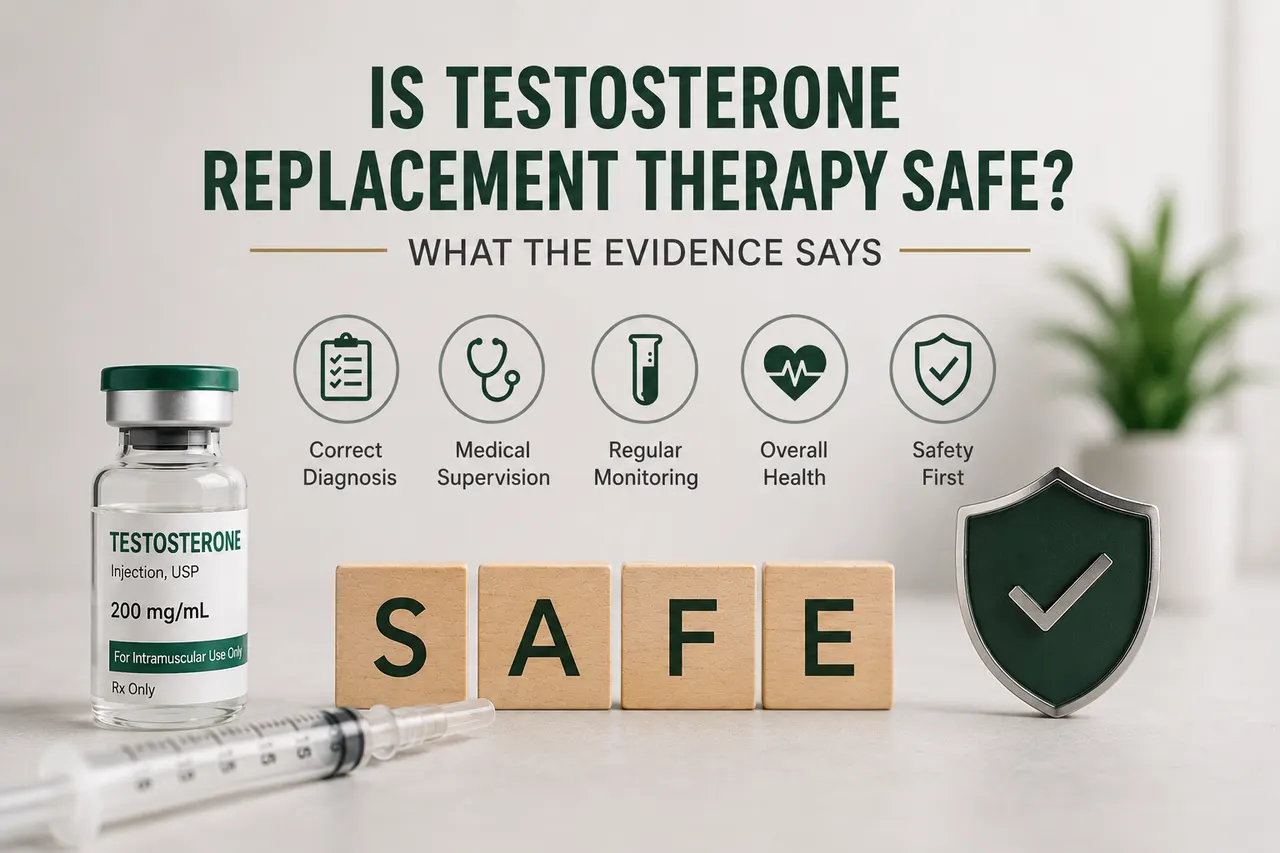
"Is it safe?" is the right question to ask — and the honest answer has an important condition attached.
The short, honest answer: it depends on who is taking it and how it is supervised. For men with confirmed hypogonadism — clear symptoms plus repeated low blood tests — Indian expert guidance considers supervised testosterone replacement therapy an appropriate and well-established treatment (Kalra et al., 2023; IDEA, 2021). For men with borderline or normal levels who simply want a boost, the same guidance specifically cautions against it. So "is TRT safe?" really becomes "is TRT appropriate for this man, and is it being monitored?"
Where safety actually comes from
This is the central idea, and it is easy to miss in the online noise: the safety of TRT lives in the diagnosis and the monitoring, not in the hormone itself. Two things make it safe or unsafe:
- Correct diagnosis. Giving testosterone to a man who is genuinely deficient restores a normal level. Giving it to a man who isn't deficient pushes a normal body out of balance for no benefit — that is where avoidable harm begins.
- Ongoing monitoring. A doctor tracks the response and watches for effects over time.
What a doctor monitors
When TRT is appropriate, a doctor checks and keeps watching:
- Red blood cell levels, which testosterone can raise
- Prostate health, with appropriate checks for the man's age
- Heart and metabolic health
- Fertility, since TRT can affect sperm production — an important conversation for younger men
- Testosterone levels themselves, to keep them in a healthy, not excessive, range
Because these need checking before and during treatment, supervision is not optional — it is what makes the treatment responsible.
Why "buying it online" is the real danger
Most of the harm linked to testosterone comes not from properly supervised TRT, but from unsupervised use — hormones bought from a gym or website, without diagnosis, without the right dose decisions, and without any monitoring. That removes every safeguard described above. Indian guidance and responsible doctors warn against this strongly. The companion guide on TRT in India explains the supervised pathway.
The honest bottom line
For the right man, properly diagnosed and monitored, TRT is a legitimate treatment with a long track record. For the wrong man, or done without supervision, it carries real risk and little benefit. The safety is earned through the process, not assumed. That is why no responsible source — including this one — will tell you "TRT is simply safe." It will tell you to get diagnosed properly first.
The safest version of TRT is the one that begins with an honest diagnosis and never skips a follow-up.
Talk to a doctor
Want a straight, evidence-based assessment? An NMC-registered doctor on Kyros can tell you whether TRT is even appropriate for you. Take the assessment.
References
- Kalra S, et al. Indian guidance on the diagnosis and management of male hypogonadism, 2023.
For general information only; not a substitute for your own doctor. Any decision about treatment is made and monitored by a doctor.