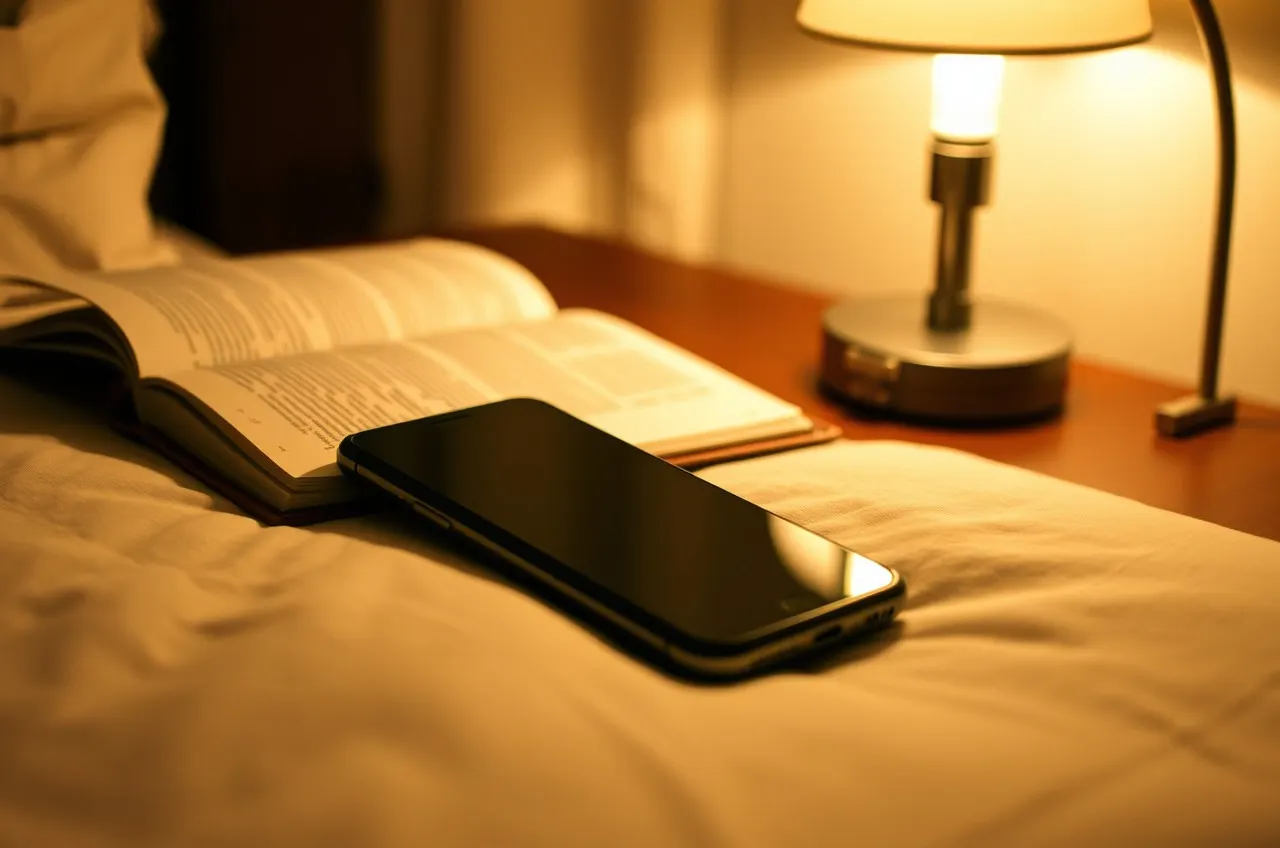
"Just five more minutes" on your phone has quietly become forty-five, and somehow it's 1 a.m. again.
"Put the phone down" is advice everyone has heard and most people ignore, partly because it's usually delivered without an explanation of what's actually happening — which makes it easy to dismiss as generic nagging rather than something with a measurable physiological basis. It has one. It's just more specific than "screens are bad."
The mechanism: what light actually does to sleep timing
Your body's internal clock relies heavily on light exposure to know when it's day and when it's night. Specialised cells in the eye detect light — particularly blue-wavelength light, which is abundant in phone, tablet, and laptop screens — and signal the brain to suppress melatonin, the hormone that helps initiate sleep. This system evolved around sunlight, campfires, and darkness; it has no built-in way to distinguish a phone screen at 11 p.m. from actual daylight; it responds to both the same way.
A controlled study by Chang, Aeschbach, Duffy, and Czeisler (Proceedings of the National Academy of Sciences, 2015) tested this directly: participants who read on a light-emitting eReader before bed, compared with those reading an identical printed book, took longer to fall asleep, had significantly suppressed melatonin levels, experienced a delayed circadian clock, and reported reduced alertness the following morning. The content was the same — a book. The only difference was the light source, and it was enough to measurably shift sleep physiology.
Why this compounds over a normal week
One late night with a screen is a minor, recoverable disruption. The problem is that for most people, screen use before bed isn't occasional — it's the default nightly pattern, which means the circadian delay isn't a one-off event but a nightly, compounding one. Combined with the broader metabolic effects of insufficient sleep documented by Spiegel, Leproult, and Van Cauter (Lancet, 1999) — changes in glucose regulation and hormone levels after even short-term sleep restriction — a habitual late-screen pattern isn't just about feeling tired the next morning. It's a nightly, low-grade disruption to a system that depends on consistency.
It's not only the light
| Factor | What it adds |
|---|---|
| Blue light | Directly suppresses melatonin release, delaying the body's sleep signal |
| Brightness in general | Even without blue-light-heavy content, high brightness itself signals "daytime" to the brain |
| Stimulating content | Work email, arguments, breaking news, or an engrossing show keep the mind alert exactly when it should be downshifting |
| Notification interruptions | Fragment whatever wind-down process has started, resetting the process |
| Doomscrolling | Combines all of the above — bright, stimulating, and open-ended, with no natural stopping point |
This is why a blue-light filter alone often produces underwhelming results — it addresses one variable out of several, while the content and brightness continue doing their own damage.
What actually helps
The goal isn't eliminating screens from your life. It's giving your body a real signal that night has arrived, instead of an ambiguous one.
- A screen cutoff 30–60 minutes before intended sleep time, even a partial one, gives melatonin release a real head start
- Dimming screen brightness in the evening, beyond just enabling a blue-light filter
- Keeping evening content low-stimulation — deliberately avoiding work messages, news, or arguments in that window
- Using an actual alarm clock instead of a phone, removing the "just checking the time" excuse to pick it up
- Dim, warm household lighting in the hour before bed reinforces the same signal screens undermine
None of this requires a dramatic digital detox. Small, consistent changes to timing and brightness move the needle more reliably than an all-or-nothing approach most people abandon within a week.
The weekend catch-up trap
A common pattern makes this harder to notice: staying up later on screens over the weekend, then sleeping in to compensate, effectively shifting the body clock later by a couple of hours — a mini jet lag repeated every week. Come Monday, the body is still on "weekend time" while the alarm insists on "weekday time," which is part of why Monday mornings feel disproportionately brutal even after what looked like extra weekend sleep. Keeping wake times relatively consistent across the whole week, weekends included, does more to protect overall sleep quality than any single weeknight screen rule on its own.
When it's more than a screen habit
If cutting evening screen time doesn't meaningfully improve sleep after a genuine few-week effort, that's a signal the screens aren't the primary driver — see our guide on other common causes of sleep-onset difficulty for what else might be at play, from stress to hormonal contributors.
Does night mode actually help?
Built-in "night mode" or warm-tone display settings reduce the blue-light component of screen output, and the evidence suggests this genuinely helps compared with a screen at full, cool-toned brightness — but it's a partial fix, not a complete one. It does nothing about overall brightness if the setting isn't paired with dimming, and it does nothing at all about stimulating content — a heated group chat or a tense work email is just as alerting in warm tones as in cool ones. Treat night mode as one useful layer among several, not a technical workaround that cancels out the need to actually put the screen down.
The phone isn't the enemy. It's just very good at doing exactly what daylight does — at exactly the wrong hour.
Talk to a doctor
If poor sleep persists despite genuinely cutting evening screen time, an NMC-registered doctor on Kyros can look for what else might be driving it. Take the assessment.
References
- Chang AM, Aeschbach D, Duffy JF, Czeisler CA. Evening use of light-emitting eReaders negatively affects sleep, circadian timing, and next-morning alertness. Proceedings of the National Academy of Sciences, 2015.
- Spiegel K, Leproult R, Van Cauter E. Impact of sleep debt on metabolic and endocrine function. Lancet, 1999.
For general information only; not a substitute for your own doctor.