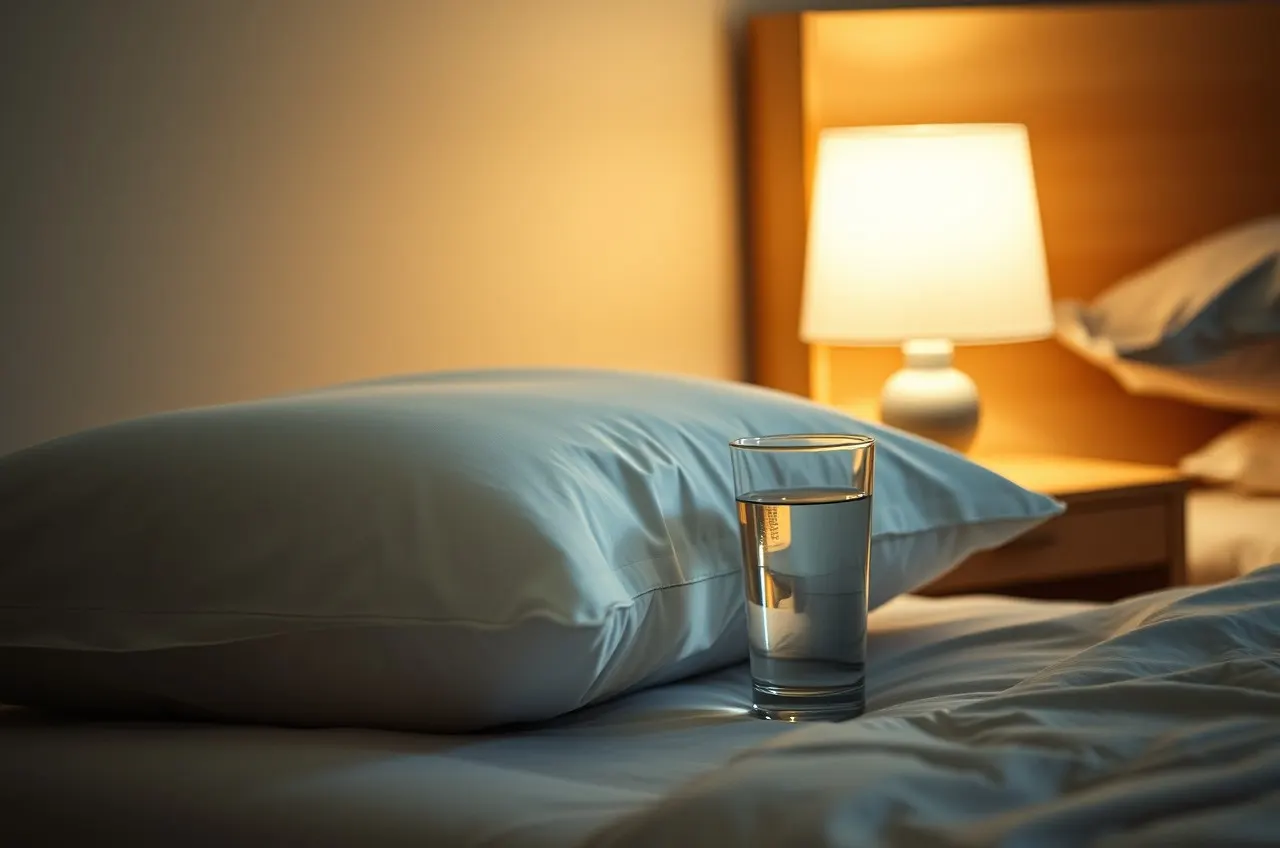
You're exhausted by 10 p.m. and wide awake by 10:30. It's been like this for months, and you've stopped expecting it to change on its own.
Difficulty falling asleep is one of the most common health complaints people never formally raise with a doctor — partly because it feels too ordinary to mention, and partly because "trouble sleeping" sounds like a lifestyle issue rather than a medical one. Sometimes it is exactly that. Often, it's something more specific with an identifiable driver, and lumping every case together under one vague label — "insomnia," "just stress," "bad sleep hygiene" — makes it harder to actually fix.
What insomnia actually is
Insomnia isn't simply "not sleeping enough." Clinically, it describes persistent difficulty falling asleep, staying asleep, or waking too early, despite adequate opportunity to sleep — happening at least three nights a week for three months or more, per the definition used in a widely cited Lancet review by Morin and Benca (2012). That duration threshold matters: a rough week before a big deadline is common and usually self-resolving. A pattern that's persisted for months is a different thing entirely, and deserves to be treated as one.
The common, distinct causes
Not all sleepless nights share the same root cause, and the fix differs depending on which one applies.
Racing thoughts and rumination. During the day, work, conversation, and general stimulation crowd out repetitive worrying. At night, with the distractions removed, unresolved stress has nowhere else to go — which is why the same worry that barely registered at 3 p.m. can feel unbearable at midnight. This is less a sleep problem and more an unmanaged-stress problem that happens to surface at bedtime; our guide on chronic stress and sleep covers that connection.
An irregular body clock. Late nights, inconsistent wake times, and shift-adjacent work schedules confuse the body's internal timing system, making the "sleepy" window arrive at an unpredictable or inconveniently late hour, independent of how tired you actually feel.
Stimulant and substance timing. Caffeine has a half-life of roughly five to six hours, meaning a 4 p.m. coffee is still meaningfully active in your system at 10 p.m. Alcohol, despite its sedating reputation, fragments sleep architecture later in the night, producing lighter, more disrupted sleep even when it helps you fall asleep faster initially.
Hormonal and medical contributors. Thyroid dysfunction — both overactive and underactive — commonly disrupts sleep in distinct ways, as do the hormonal shifts of perimenopause. These are exactly the kind of drivers that habit-focused advice ("try a wind-down routine") won't touch, because the problem isn't the routine.
An undiagnosed sleep disorder. Persistent sleep-onset difficulty is sometimes mistaken for ordinary insomnia when the actual driver is something like restless legs syndrome or, in the case of nighttime waking rather than sleep-onset trouble, sleep apnea — covered in our sleep apnea guide.
Why unaddressed sleep loss is more than an inconvenience
This isn't only about how tired you feel the next day. A landmark 1999 study by Spiegel, Leproult, and Van Cauter (Lancet) found that even short-term sleep restriction in healthy young adults produced measurable changes in glucose tolerance and hormone regulation resembling patterns typically seen in far older adults. Chronic sleep-onset difficulty, left unaddressed for months, isn't a purely quality-of-life issue — it interacts with metabolic and hormonal health in ways that compound over time.
What actually helps, and what doesn't
| Approach | Why it works, or doesn't |
|---|---|
| Consistent wake time | Anchors the body clock more reliably than a consistent bedtime does |
| Cutting caffeine after early afternoon | Removes a stimulant still active at bedtime |
| A wind-down routine | Signals the body clock, but won't fix a hormonal or medical driver |
| "Trying harder" to sleep | Counterproductive — anxiety about not sleeping is itself a common cause of not sleeping |
| Screens right before bed | Delays the body's natural melatonin release |
That last point is significant enough to cover on its own — see our guide on screen time and sleep quality for the mechanism.
The bed-anxiety loop
There's a second-order problem that develops after weeks or months of poor sleep, independent of whatever started it: the bed itself becomes associated with wakefulness and frustration rather than rest. After enough nights spent lying awake, watching the clock, and feeling the familiar dread of "here we go again," the brain starts to link the bed and bedtime with alertness and anxiety rather than sleep — a learned association that keeps the problem going even if the original cause has resolved. This is part of why "trying harder" to sleep so often backfires, and why getting out of bed to do something calm and low-stimulation when sleep isn't coming, rather than lying there willing it to happen, is a more effective response than it might sound.
When it's time for a proper evaluation
Sleep hygiene advice works for sleep hygiene problems. It doesn't work for a thyroid problem, and expecting it to just delays finding what actually does.
If sleep-onset difficulty has lasted more than a few months, resisted the basics above, or comes with other symptoms — fatigue, mood change, weight change, snoring — it's worth a structured evaluation rather than another round of generic advice. A doctor can screen for the hormonal and medical contributors that a self-directed sleep hygiene effort simply can't address, and refer onward — for a sleep study, or to a mental health professional — when that's what's actually indicated.
The nights add up quietly. So does the cost of assuming there's nothing to be done about them.
Talk to a doctor
Months of trouble falling asleep, with no clear cause you've been able to pin down — an NMC-registered doctor on Kyros can look for what's actually driving it. Take the assessment.
References
- Morin CM, Benca R. Chronic insomnia. Lancet, 2012.
- Spiegel K, Leproult R, Van Cauter E. Impact of sleep debt on metabolic and endocrine function. Lancet, 1999.
For general information only; not a substitute for your own doctor.