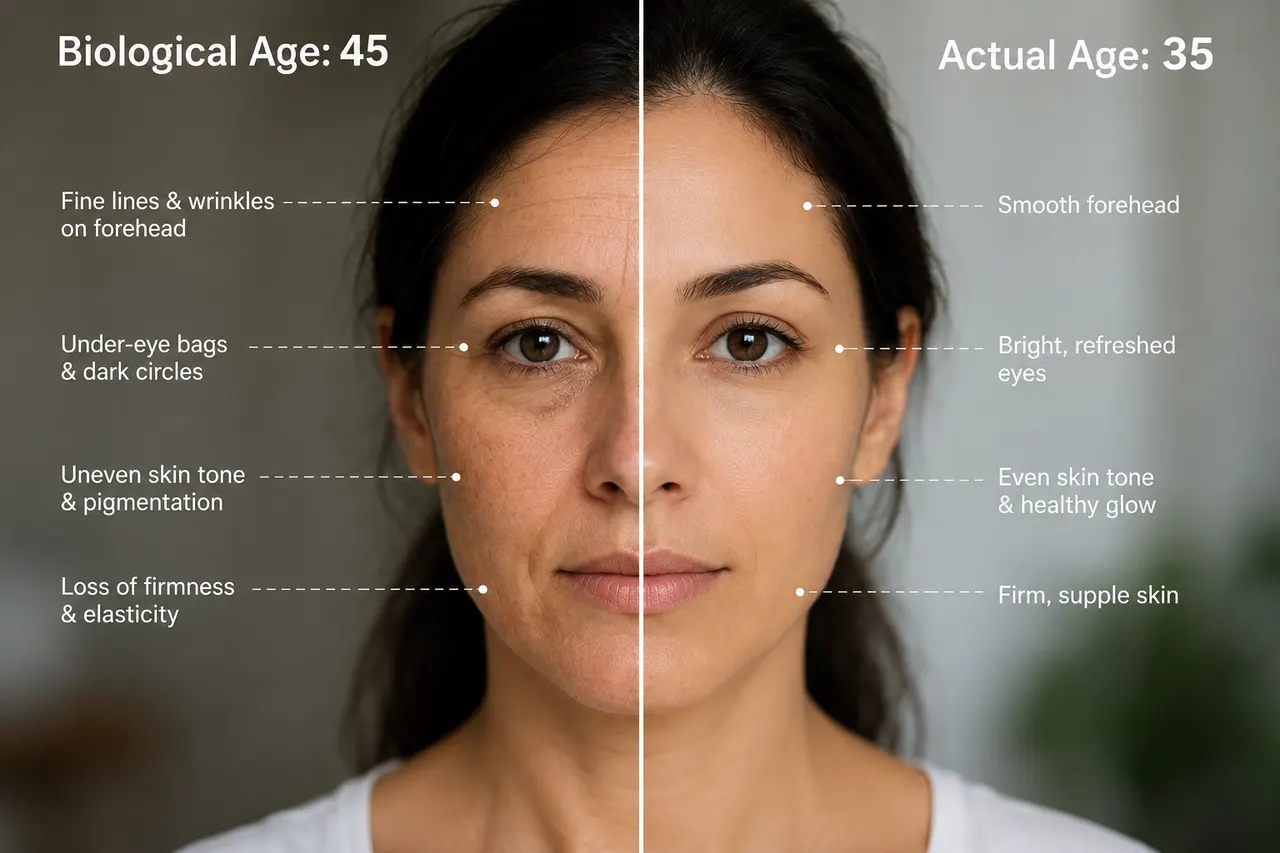
Two people can share a birthday and be ageing at completely different speeds. The calendar isn't the whole story.
You have two ages. One is the number on your birth certificate — your chronological age — and it only goes one way. The other is your biological age: an estimate of how well your body is actually working compared to that number. The useful, hopeful part is that biological age is shaped by things you can change.
What biological age actually means
Think of two men who are both 40. One has steady blood sugar, good blood pressure, healthy cholesterol, and decent fitness. The other has creeping sugar, high blood pressure, and carries extra weight around the middle. On paper they are the same age. Inside, their bodies are ageing very differently — and their future health reflects that, not the birthday.
That difference is what "biological age" is trying to capture: the condition of your body, not the count of your years.
How it's estimated (honestly)
There is no single perfect "ageing test," so it is worth being clear-eyed:
- The practical version is your core health markers read together — blood pressure, blood sugar (HbA1c), cholesterol, weight, waist, and fitness. This is what most doctors actually use, and it is genuinely informative (see blood markers that predict health).
- Newer lab tests estimate biological age from things like DNA patterns. These are interesting but still developing, can be expensive, and are not yet essential for most people.
So the honest message: you do not need a fancy test to know how you are ageing. Your standard numbers already say a great deal.
What actually moves it
This is where biological age becomes useful rather than just interesting. The markers that define it are the same ones that respond to everyday care:
- Steadier blood sugar and better metabolic health
- Healthy blood pressure and cholesterol
- Regular movement and fitness
- A healthy weight and waist
- Good sleep and managed stress
Improving these is what "a younger biological age" means in practice. It is not a magic reversal — it is your body working better, with measurable numbers to show it.
The point of knowing
Biological age is less a scoreboard and more a motivator and a map. It turns vague worry about ageing into specific, changeable numbers — and those numbers respond to action far more than the calendar ever will.
You can't change your birthday. You can change how your body shows up to it.
Talk to a doctor
Curious how your body is really doing for your age? An NMC-registered doctor on Kyros can read your numbers together and guide what to improve. Take the assessment.
References
- General preventive medicine literature on ageing biomarkers. (Specific sources to be confirmed by the reviewing doctor at publish.)
For general information only; not a substitute for your own doctor.