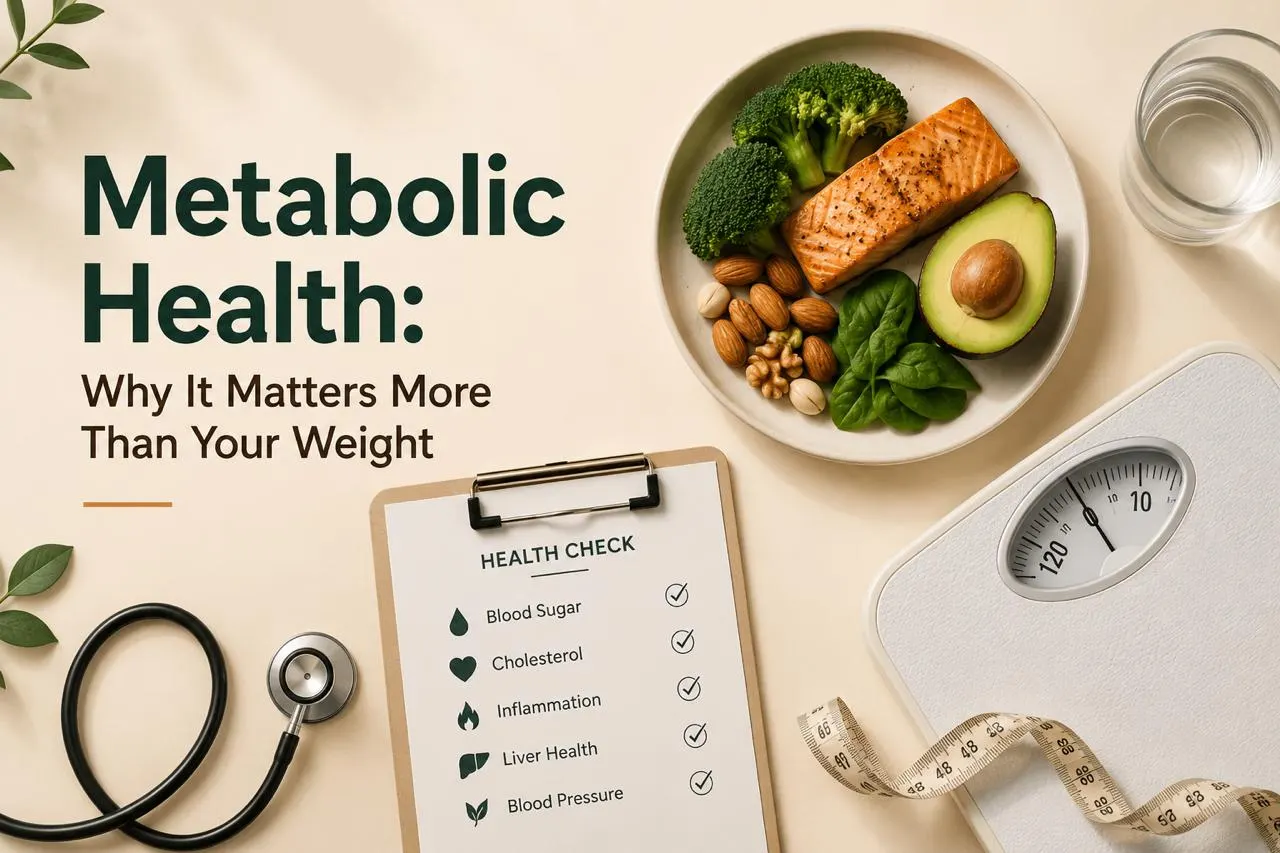
The bathroom scale answers one question. Metabolic health answers the one that actually predicts your future.
If there is a single idea worth taking from this whole section, it is this: how your body handles energy matters more than what you weigh. That ability — to manage blood sugar, cholesterol, blood pressure, and fat storage — is your metabolic health. It quietly drives the risk of diabetes, heart disease, fatty liver, and more. And crucially, you can be slim and still be in trouble.
What metabolic health actually is
Every day your body manages a flow of energy from food. Metabolic health is how well that system runs:
- Keeping blood sugar steady
- Keeping cholesterol and triglycerides in range
- Keeping blood pressure healthy
- Storing fat safely, not around the organs
When these stay in good ranges, your risk of the big chronic diseases stays low. When several drift out of range together, doctors call it metabolic syndrome — and it is a strong warning sign.
The slim-but-unhealthy trap
Here is the part that surprises people. Some slim people are metabolically unhealthy — they have high blood sugar, high triglycerides, or fat packed around their organs despite a "normal" weight. In India this is so common it has a name: "thin outside, fat inside." It is why judging health by weight alone — or even BMI alone — misses real risk. Our guide on BMI for Indians explains why waist size matters alongside weight.
The flip side is also true: some people in a higher weight range are metabolically healthier than they look. Weight is a clue, not the verdict.
Why it sits behind so many conditions
Metabolic health is the common root under several things covered across Kyros:
- The slide toward prediabetes and diabetes
- Much of PCOS, through insulin
- A large share of low testosterone in men
- Heart and liver risk
Improve metabolic health, and you often improve several of these at once. That is why it is the engine room of preventive health.
How to check yours
You do not need exotic tests. Four measures tell most of the story:
| Measure | Healthy direction |
|---|---|
| Waist size | Below ~90 cm (men) / ~80 cm (women) |
| Blood pressure | In the normal range |
| Blood sugar / HbA1c | In the normal range |
| Cholesterol panel | Triglycerides and harmful cholesterol in range |
A doctor reads these together, with your waist and family history, to judge your true metabolic health — see blood markers that predict health.
Forget the scale for a moment. Ask instead how well your body handles energy — that's the number that shapes your next thirty years.
Talk to a doctor
Want a clear read on your metabolic health? An NMC-registered doctor on Kyros can check the right measures and explain what they mean. Take the assessment.
References
- Anjana RM, et al. ICMR-INDIAB national study. Lancet Diabetes & Endocrinology, 2023.
- Misra A, et al. Consensus statement for Asian Indians. JAPI, 2009.
For general information only; not a substitute for your own doctor.