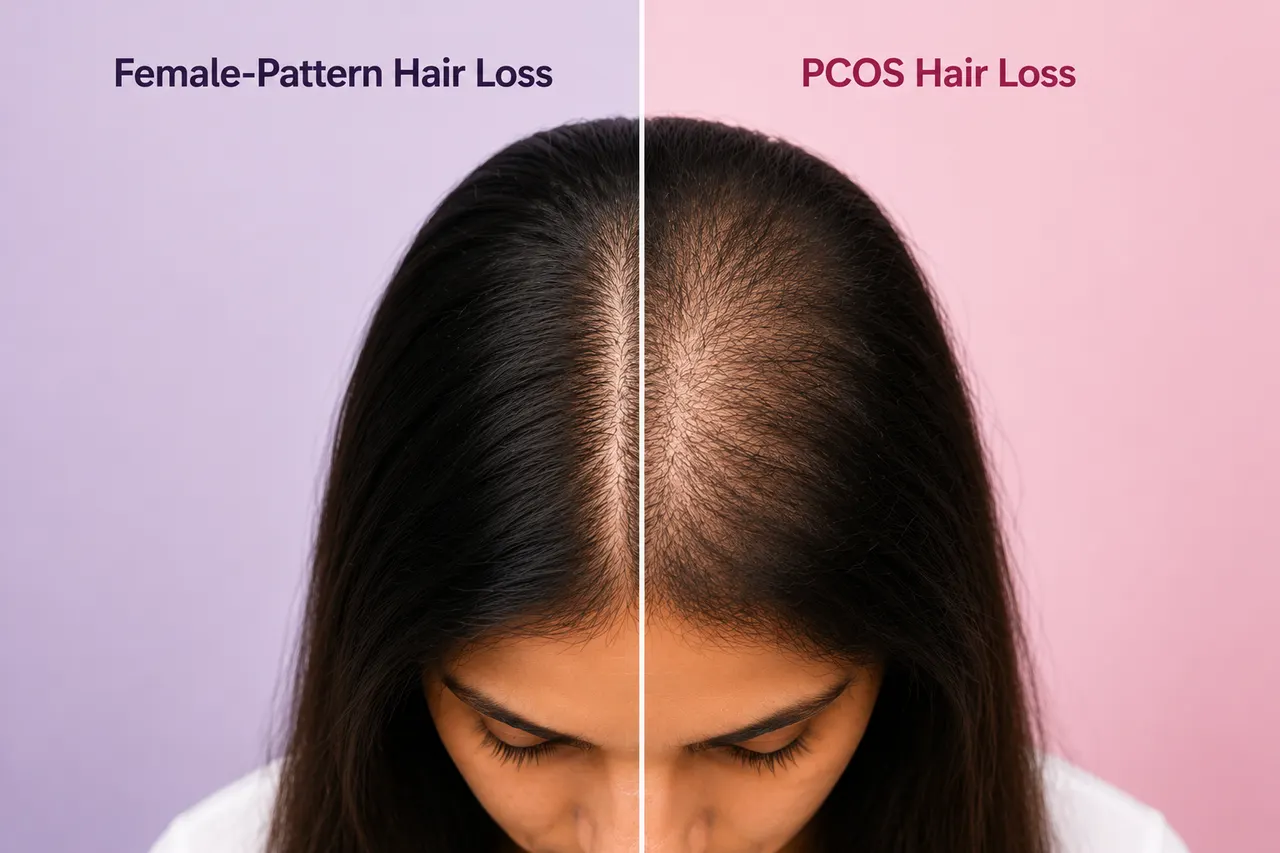
Two women, the same thinning hair, two different stories underneath.
When a woman's hair thins, two causes top the list: female-pattern hair loss and PCOS-related hair loss. They can look similar in the mirror but come from different places — one mostly genetic, the other driven by hormones. Telling them apart matters, because the care follows the cause. And often, both are present at once.
The difference at a glance
| Female-pattern hair loss | PCOS hair loss | |
|---|---|---|
| Main driver | Genetics (family history) | Raised male-type hormones, insulin |
| Pattern | Widening parting, thinner crown | Thinning crown, sometimes frontal |
| Comes with | Usually hair changes alone | Irregular periods, acne, extra facial/body hair, weight gain |
| Onset | Gradual, often with age | Often younger, alongside PCOS signs |
| The clue | Hair is the only issue | Hair is one of several signs |
The single most useful question: is the hair thinning happening alone, or with other PCOS signs? Hair alone leans pattern loss. Hair plus irregular periods and acne leans PCOS.
Why they overlap
PCOS raises male-type hormones, and those hormones can trigger or speed up pattern hair loss in women who are already genetically prone. So a woman can genuinely have both — the genetic tendency and the PCOS push on top. This is common, and it is why treating just one side often disappoints.
How a doctor tells them apart
A doctor combines three things:
- The pattern of thinning on the scalp
- Your history — periods, acne, weight, family history
- Blood tests — hormones, iron, vitamin D, thyroid
If PCOS signs are present, the PCOS symptoms guide is worth reading alongside this. If hair is truly the only issue, the focus shifts to pattern loss and the common hair-loss causes.
Why getting the cause right matters
Because the plans are different. PCOS-related loss improves most when the hormone and insulin side is managed, not just the scalp. Pattern loss is handled on its own track. Guessing wrong wastes months — a proper check does not.
The mirror shows the thinning. Only the full story shows the reason.
Talk to a doctor
Not sure which kind of thinning is yours? An NMC-registered doctor on Kyros can check the pattern and the hormones together. Take the assessment.
For general information only; not a substitute for your own doctor.