For many women, years of "irregular periods" were a signal nobody quite read.
PMOS — PolyendocrineMetabolic Ovarian Syndrome, the condition most people know as PCOS or PCOD — is one of the most common hormone conditions in Indian women. A national study found it in close to 1 in 5 women by wider criteria (Ganie et al., JAMA Network Open, 2024). The signs are easy to dismiss one by one, but together they tell a clear story. (New to the name? See why we call it PMOS.)
What does PMOS feel like?
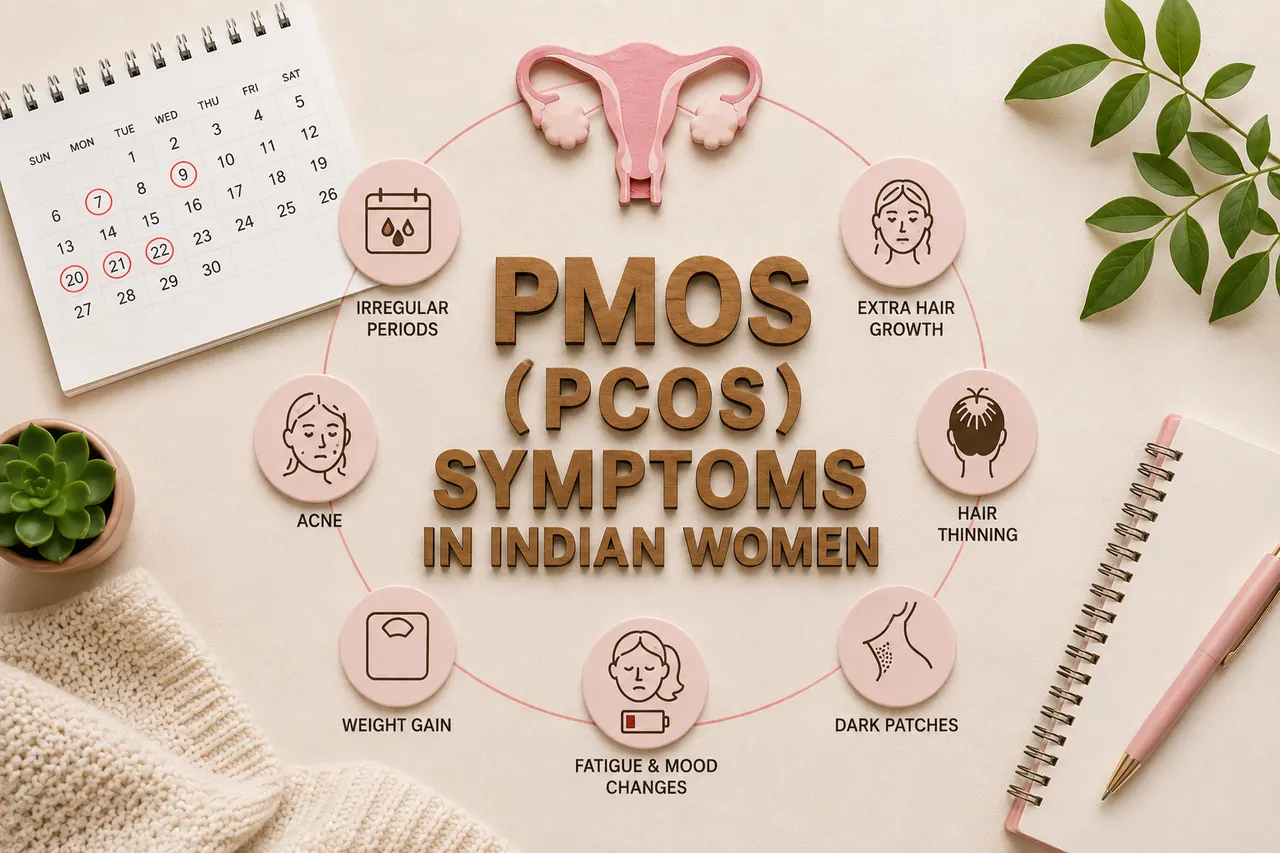
The common signs include:
- Irregular, late, or missed periods — the most common clue
- Acne, especially along the jaw and chin
- Weight gain, or great difficulty losing weight
- Extra hair on the face, chin, or body
- Hair thinning on the scalp
- Dark skin patches at the neck or underarms
- Mood changes and low energy
PMOS is really an insulin and metabolic story that shows up on the skin, the scale, and the calendar at the same time. That metabolic root is exactly why the name puts "metabolic" front and centre.
Why does it happen?
In PMOS, the ovaries and hormones fall out of their usual rhythm, often alongside insulin resistance — where the body needs more insulin to do its job. Higher insulin nudges up male-type hormones, which drive the acne, extra hair, and irregular cycles. This is why it is not simply a "period problem."
What does your doctor check?
There is no single test. A doctor looks at the pattern:
| Check | What it shows |
|---|---|
| Period history | Whether cycles are irregular |
| Signs of raised hormones | Acne, extra hair, scalp thinning |
| Blood tests | Hormones, blood sugar, insulin, thyroid |
| Ultrasound (sometimes) | The look of the ovaries |
The diagnosis is made by putting these together — which is why a doctor's review matters more than one report. Learn when irregular periods point to PMOS.
When should you see a doctor?
See a doctor if your periods have been irregular for several months, or if irregular cycles come with acne, weight gain, or extra hair. Catching PMOS early makes it far easier to manage and protects your long-term health.
PMOS rarely shouts. It hints — and the hints are worth listening to.
Talk to a doctor
If these signs feel familiar, an NMC-registered doctor on Kyros can review your symptoms and guide the right tests. Take the PMOS assessment.
References
- Ganie MA, et al. Prevalence and clinical features of PCOS in India (ICMR national study). JAMA Network Open, 2024.
For general information only; not a substitute for your own doctor. PCOS/PCOD remain the medically recognised terms.