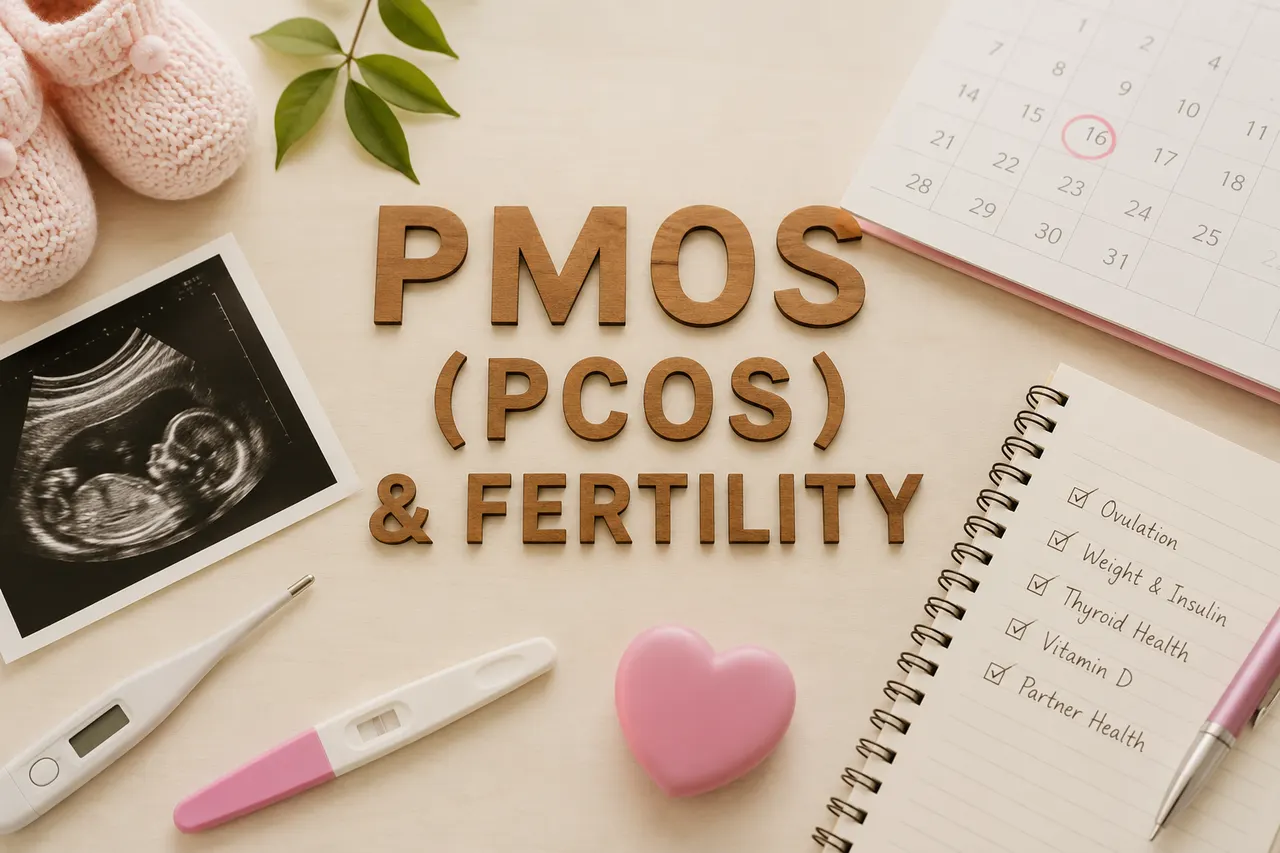
If you have PMOS and are hoping to start a family, the fear of "what if I can't" is real — and usually heavier than the facts deserve.
Here is the reassuring truth first: most women with PMOS — the condition known as PCOS — can get pregnant. It can make it take longer, because it affects ovulation, but it does not mean the door is closed. With timely, guided support, pregnancy is very possible for the great majority of women with PMOS.
How PMOS affects fertility
Pregnancy needs ovulation — an egg being released. In PMOS, ovulation can become irregular or paused, so eggs are not released on a steady schedule. That is why cycles are unpredictable and why timing can be harder. The egg supply itself is usually fine; it is the release that is off-rhythm. This is a problem of timing and signals, not a permanent block — and because the driver is often metabolic, improving it can help restore the rhythm.
What a doctor checks when you're trying to conceive
A doctor looks at the whole picture, because several fixable things affect PMOS fertility:
- Whether and when you ovulate — tracked through cycles and tests
- Weight and insulin, which strongly influence ovulation
- Thyroid, which must be in range for a healthy pregnancy (see thyroid in pregnancy)
- Vitamin D and general health
- Your partner's health too, since fertility is shared
Often, steadying the cycle — through weight and insulin support and a doctor's guidance — is enough to restore regular ovulation. Where more help is needed, a doctor can guide the next steps safely.
What you can do now
Three things help while you prepare:
- See a doctor early rather than waiting many months, especially if your periods are very irregular.
- Work on insulin and weight if relevant — even modest changes can restore ovulation (see PMOS and weight gain).
- Get your thyroid and basic health checked before pregnancy, not after.
When to seek help
If you have PMOS and have been trying for several months without success, or your cycles are very irregular, that is the moment to talk to a doctor — not a sign to give up. PMOS responds well to early, structured support.
PMOS can make the road longer, not closed. The earlier you have a guide, the smoother it tends to be.
Talk to a doctor
Planning a family with PMOS? An NMC-registered doctor on Kyros can review your cycles and guide the right first steps. Take the assessment.
References
- Ganie MA, et al. Prevalence and clinical features of PCOS in India (ICMR national study). JAMA Network Open, 2024.
For general information only; not a substitute for your own doctor. PCOS/PCOD remain the medically recognised terms.